
Emergency Water Damage Restoration Near Me: What Paramus Homeowners Should Do First
Emergency water damage restoration in Paramus typically costs between $3,500 and $12,000 depending on how fast the water is stopped and how much material absorbed it before extraction began. The single most important variable isn’t the amount of water - it’s the number of hours that pass before drying equipment is actually running. If you’d rather not handle the first steps yourself, call (640) 333-9625 and a live dispatcher will walk you through it.
Putting down towels and calling your insurance company are the two things every homeowner does first. They’re also the two things that have almost no effect on whether the damage costs $7,000 or $25,000. What happens in the first two hours does. We’ve been called to homes on Forest Avenue and Farview Terrace where the water was the same, the house was the same, and the final bill was $11,000 apart. The difference was never luck.
What Actually Happens in the First Two Hours
Water moves through a Paramus home in a predictable order, and knowing that order tells you exactly what to move first. Drywall wicks moisture upward at a rate that surprises most homeowners - a half-inch of standing water in a finished basement can climb four inches up the wall in the first hour alone. Baseboards pull water in from the bottom edge. Carpet padding acts like a sponge and doubles its weight within 20 minutes. The floor under it - if it’s plywood or OSB - starts swelling at the seams, and once subfloor swelling starts, it doesn’t un-swell. It gets replaced.
The order that matters:
- Stop the source first. If it’s a supply line, the shutoff is typically at the water meter or the main valve where the line enters the house. If it’s sewage, leave it alone and stay out - that requires a specialist.
- Move what you can lift quickly. Furniture, area rugs, shoes, cardboard boxes, anything with legs that’s absorbing from the bottom. Get it onto a dry floor, not just onto a towel on the same wet floor.
- Pull the padding only if you can do it without a utility knife in wet conditions. Carpet can often be dried and reinstalled. Padding almost never survives contact with contaminated water, and leaving it in place just holds moisture against the subfloor for hours longer.
- Don’t use a household shop vac as a primary extraction tool for anything beyond a few gallons. It can’t pull water out of the material the way extraction equipment does, and it buys you very little time.
Kill the Power the Right Way
In many Paramus homes - especially the split-levels and raised ranches built in the 1950s through the 1970s - the breaker panel sits in the basement or the utility room that’s now under water. That creates a specific sequence problem: you need the power off, but you can’t reach the panel without standing in or near water. The rule we give every homeowner is simple: do not enter standing water to reach a panel. If the panel is dry and reachable, flip the main breaker with dry hands while wearing rubber-soled shoes. If the panel is wet, behind water, or below the water line on the wall, call the utility company and a restoration dispatcher immediately - do not attempt it.
This is not the moment for a YouTube tutorial. Electricity and standing water in a New Jersey basement is a genuinely dangerous combination, and the breaker in these older homes is not always where the label on the door says it is. A trained professional can read the situation in person and make the call safely.
What to Photograph Before You Touch Anything
Your insurance company will send an adjuster with a checklist, but no adjuster sees what you see in the first ten minutes. Here’s what we tell clients in Paramus to photograph, in this exact order, before moving anything:
- The water line on every affected wall. Use a tape measure in the photo if you can - even a yardstick works. The height of the line tells the adjuster how far wicking has already gone.
- Every item that is touching water at the time of discovery. Baseboards, furniture legs, box bottoms, appliances. You’re photographing contact points, not just the standing water.
- The source of the water, if it’s visible. A cracked supply line, a failed water heater tank, a sump pit overflowing. The cause codes differently in a claim than the result.
- Any labels or model numbers on damaged equipment, furnaces, water heaters, or dehumidifiers. Adjusters use these to assign replacement value. You can’t recover from memory what a label could have told you.
- Serial numbers on anything that will be removed and discarded. If it’s going to the curb, photograph it first and record the number. Once it’s hauled, that information is gone.
We saw a claim in the Paramus area last winter where the homeowner had a photo of the water line with a tape measure against the wall. That single image saved the claim from being underpaid by more than $4,000, because it forced the carrier to cover the full affected wall section instead of just the visibly damaged lower third. Photographs with a scale reference beat photographs alone every time.
Why the Restoration Company Comes Before the Insurance Carrier
Most homeowners call their insurance company first because it feels responsible. Here’s the problem: the insurance call center rep isn’t the one who shows up. They can start a claim, give you a claim number, and tell you to “mitigate further damage.” What they can’t do is tell a crew to roll to your house. The carrier’s first question will also be, almost always, “Has mitigation started?” - because every hour of delay adds to the claim total and the carrier knows it.
The correct sequence for a Paramus homeowner is this: call the restoration company first, then call the carrier. A restoration company that bills the carrier directly, as Floodline Restoration Co. does, will handle that first call differently than one that insists on payment upfront. We get the claim number from you after the fact, log our scope of work, photos, and moisture readings, and work with the adjuster directly. We run Dri-Eaz and Phoenix drying equipment with daily readings, and we hand those readings to the carrier the same way we hand them to you - in a plain log, not a stack of jargon. The homeowner never plays messenger between our office and the adjuster’s.
What a Legitimate 24/7 Emergency Dispatcher Should Tell You
If you’re searching “emergency water damage restoration near me” in Paramus at two in the morning, you’re likely dealing with a flooded basement and a rising sense that this is going to be expensive. The companies that answer those searches are not all the same. Here’s what a legitimate 24/7 dispatcher should tell you on that first call, before a crew ever arrives:
- Ask them the response time and have them give you a real number. Not “ASAP.” A real dispatcher will say something like “we’ll have a crew to you inside 90 minutes” - and then actually do it, with a call when the truck is 15 minutes out.
- They should ask about your breaker panel and tell you not to enter standing water. If the dispatcher doesn’t mention basic electrical safety in a flooded basement scenario, you’re talking to an answering service, not an operator who knows restoration work.
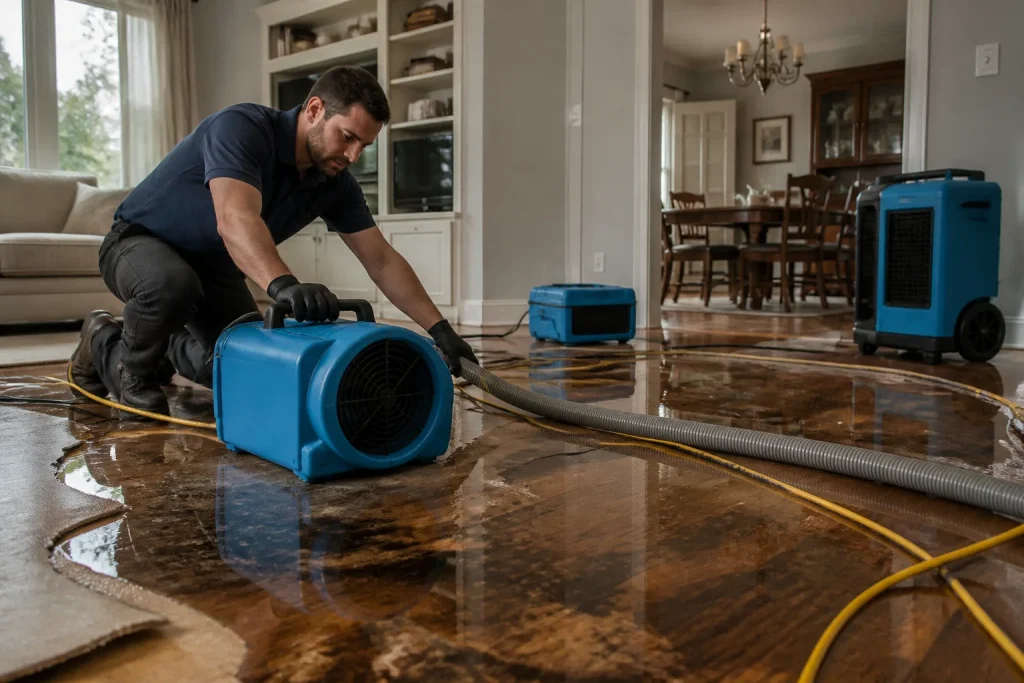
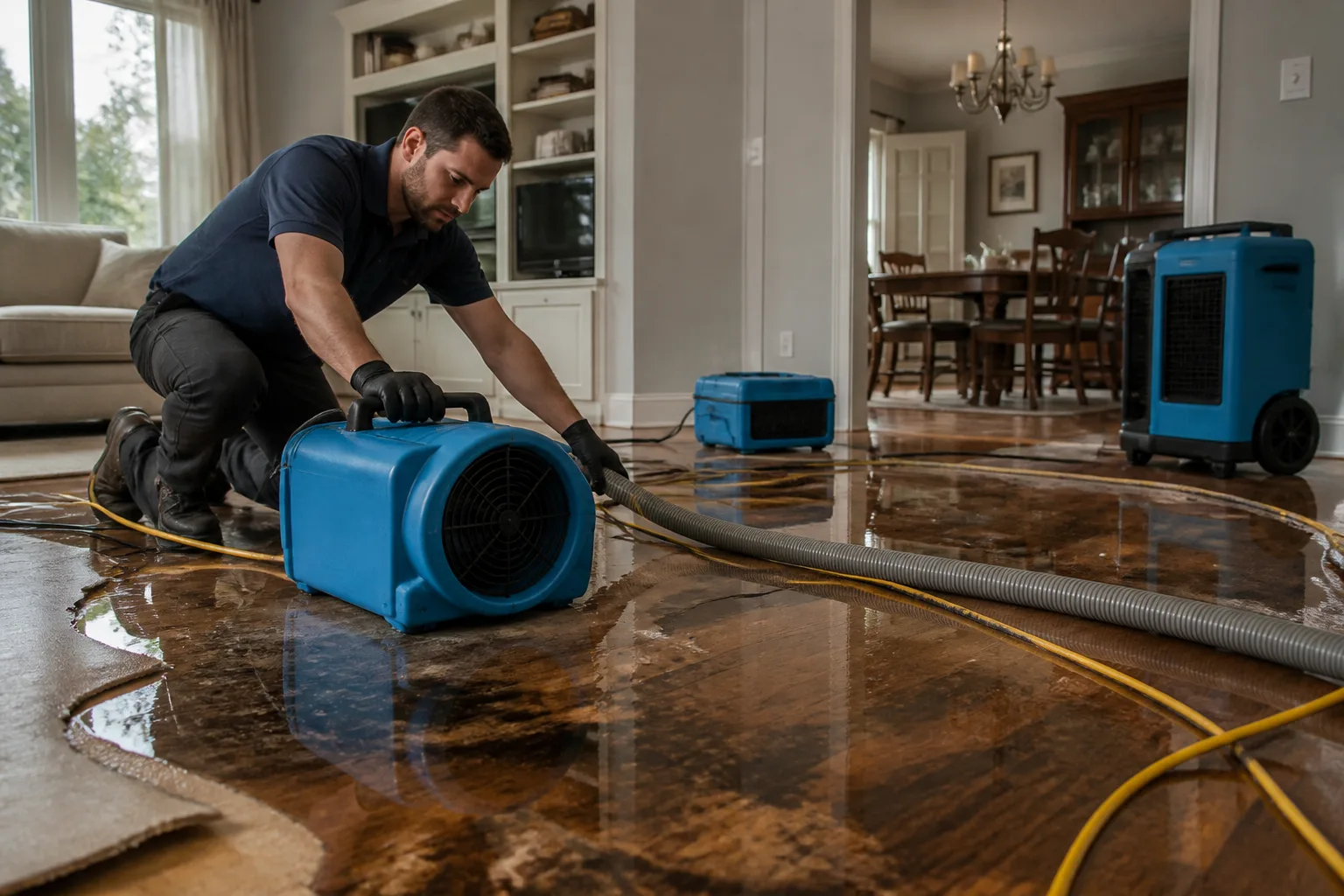
- They should quote you a single-visit expectation for extraction and drying setup. Professional-grade equipment - Dri-Eaz, Phoenix, XPOWER, and B-Air are the brands we run - should be on site and running the first visit, with the same crew returning daily for readings until the dry standard is met. Not a crew that leaves you a rental machine and disappears.
- They should explain their billing process in the first five minutes. “We bill your carrier directly” is a specific statement. “We’ll figure out billing when we get there” is not.
If the person on the phone can’t answer those four things, call the next number. Floodline Restoration Co. has been doing this in the area since 2010, and every call is answered by a live dispatcher - not a recording, not a third-party call center - 24 hours a day, every day of the year. The first call is the one that sets the tone for the next six weeks.
A Real House, a Real Timeline
We pulled a job out of a colonial over near Paramus High School a few months ago. The homeowner was a retired teacher, lived in the house for 31 years. A washing machine supply line let go sometime after dinner. By the time he came downstairs at 10 p.m., water had covered the finished half of the basement and wicking had started up the drywall on two walls. He called us first, then his carrier. Our crew was running extraction by 11:20 p.m. Drying equipment was placed and stabilized by midnight. Daily moisture readings for seven days. The dry standard was met, a small section of baseboard and pad was replaced, and the carrier paid the claim without a fight because the documentation was complete from hour one.
He told us later that the thing he was most grateful for wasn’t the speed. It was that the same two guys came back every day for a week. He knew their names. No inherited crew, no mid-job handoff. That’s how we believe the work is supposed to go - one crew from the floodline to the finish.
When to Call a Pro vs. When You Can Handle It
Some water events are genuinely small. A toilet overflow with clean water that’s mopped up inside thirty minutes, with no baseboard swelling and no carpet pad involved, can often be handled with a wet/dry vac and a fan. Here’s the line we draw: if water has been standing for more than an hour, if it’s touching drywall, if it’s under any flooring, if it’s from a sewage line, or if you can’t reach the breaker safely - call a professional. That’s not us trying to sell you a job. That’s us telling you what we’d tell a neighbor. The cost of a professional assessment is a fraction of what a misjudged dry-out costs six weeks later, when the musty smell shows up in the guest room and you realize the subfloor has been damp the whole time.
Related services in Paramus: Water Damage Restoration in Paramus, Mold Remediation in Paramus, and Fire & Smoke Damage Restoration in Paramus.
The Bottom Line
The first two hours set the price. Turn the water off if it’s safe to do so. Kill the power without entering standing water. Photograph the water line with a scale reference and every contact point before you move anything. Call a restoration company before your carrier. And hold the dispatcher to a real response time, a single-visit setup, direct billing, and a clear safety walkthrough on the phone. If you’re in Paramus and need help, Floodline Restoration Co. offers free estimates - call (640) 333-9625. We’ll be there when we say.
Learn more about our Floodline Restoration Co. home services, or call us directly for an estimate on any water, mold, fire, or reconstruction job.
Frequently Asked Questions
Floodline Restoration Co. aims to have a certified crew on site within 90 minutes of your call anywhere in the Paramus area. A live dispatcher answers the phone 24/7, gives you an ETA on that first call, and updates you when the truck is 15 minutes out. We run extraction on the first visit, not on a follow-up.
It depends on the source of the water and your specific policy, but sudden and accidental water damage from a burst pipe or failed supply line is covered by most standard New Jersey homeowners policies. Gradual leaks, flood water, and sewage backup often require separate coverage. We bill carriers directly and hand documentation - photos, moisture logs, and scope - straight to your adjuster so you’re never the go-between. Call (640) 333-9625 and our dispatcher can walk through what to ask your carrier.
Fans and a household dehumidifier can handle small, clean-water spills that are caught immediately. If water has been standing for more than an hour, touched drywall, seeped under flooring, or comes from anything other than a clean supply line, the answer is almost always a professional dry-out. We run professional-grade Dri-Eaz and Phoenix dehumidifiers and B-Air movers placed per a moisture map, with daily readings logged until the dry standard is met.
It’s our written guarantee, tied to our K.E.Y.S. values code: Krafted right, Every time, Your home first, Standing behind it. If the job isn’t done right, we make it right - no arguing, no paperwork battles. Every job from water damage restoration to full reconstruction carries it. The line the water left is where we start, and the job isn’t finished until you and the carrier both have the dry standard in writing.
Written by Curt Bowman, Owner at Floodline Restoration Co., serving Paramus since 2010.
Need Damage Restoration Help?
Call Floodline Restoration Co. - licensed & insured, here with fast after-hours help in Paramus.
(640) 333-9625