
Last updated August 25, 2026
Free visual inspection and a written scope of work before any mitigation begins - photos, moisture readings, and drying logs go in your claim file
The scope we write is the scope we bill. Anything new gets shown to you, in writing, before we touch it.



 Before
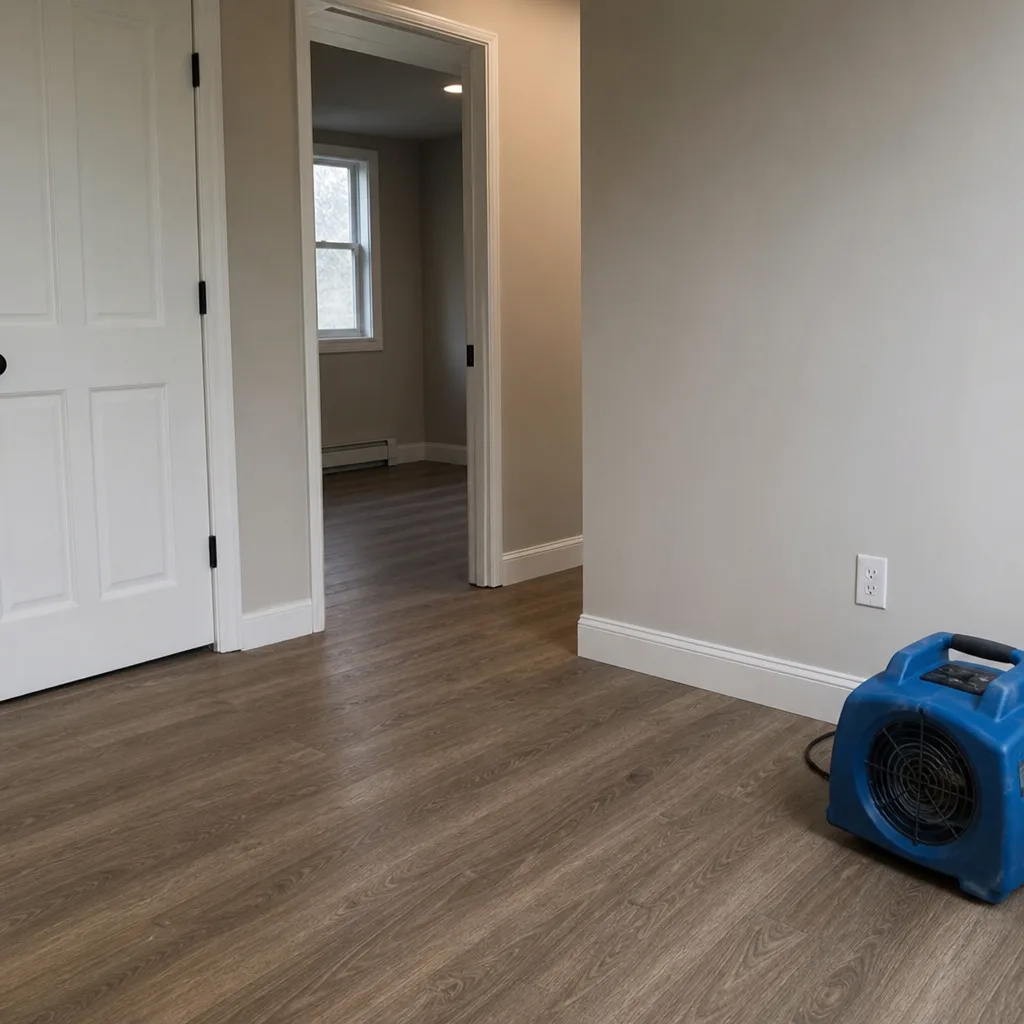 After
After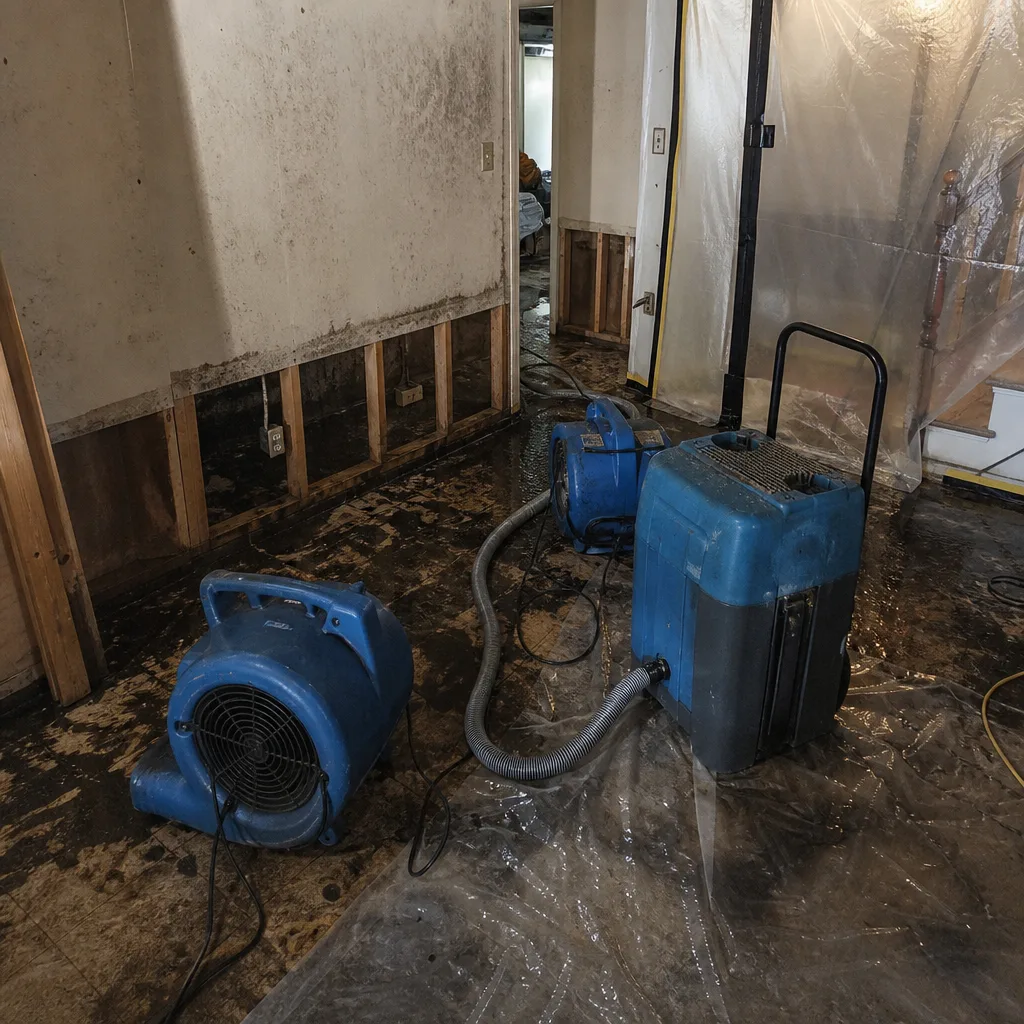 Before
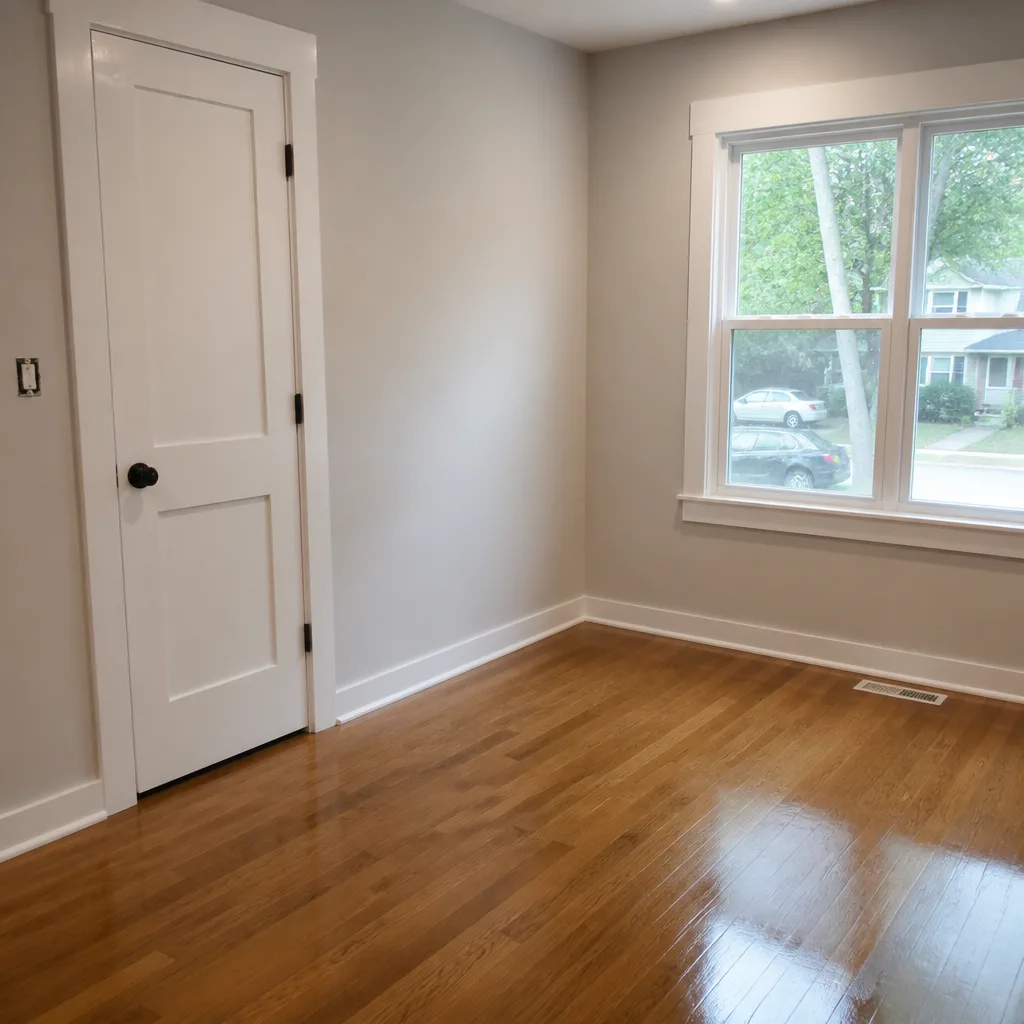 After
After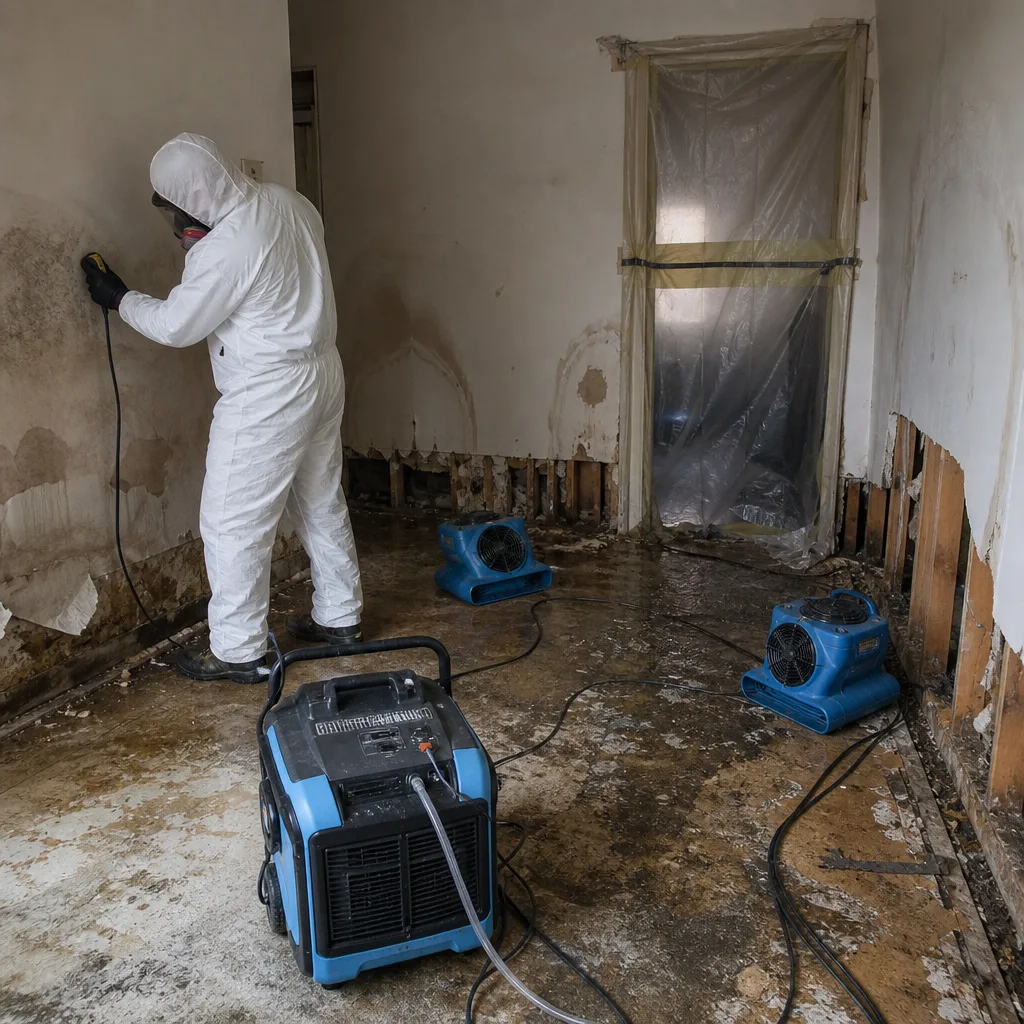 Before
 After
AfterDIY vs Professional Damage Restoration: The Paramus Homeowner’s Decision Guide
Bergen County basements flood in patterns that repeat themselves decade after decade. The Saddle River and Sprout Brook rise, the clay-heavy soil around Paramus Road holds water against foundation walls, and sump pumps fail during the exact thunderstorms that knock out power to half the borough. What surprises most Paramus homeowners is not that water got in. It’s that the cleanup decision they make in the first six hours determines whether they’re dealing with a three-day drying job or a three-month mold remediation. This guide walks through where DIY stops making sense, what professional restoration actually costs in this part of Bergen County, and how to avoid the mistakes we see repeated on Farview Avenue, Midland Boulevard, and every other street in town.
Quick Answer
DIY damage restoration works for small, clean-water spills caught within the first hour, roughly anything under 15 square feet with no wall or subfloor penetration. Anything involving sewage, groundwater, hidden moisture behind drywall or under flooring, or water that sat for more than a few hours needs professional equipment and moisture mapping that rental fans cannot replicate. In Paramus, where homes average 40 to 70 years old and many basements have finished space, the average professional water damage job runs between $2,800 and $6,500 before reconstruction.
Table of Contents
- The DIY Projects That Actually Make Sense
- When DIY Goes Wrong: Hidden Moisture in Paramus Homes
- Professional Equipment vs. What You Can Rent
- Real Cost Comparison: Paramus Market Numbers
- Insurance and DIY: What Your Carrier Expects
- The Mold Timeline: Why Hours Matter
- Common Mistakes to Avoid
- When to Call a Professional
- Frequently Asked Questions
The DIY Projects That Actually Make Sense
We’re not going to tell you every water problem needs a restoration crew. That would be dishonest, and it’s not how we’ve run our business in Paramus since 2010. Some jobs are genuinely manageable for a homeowner with the right tools and a realistic sense of the scope.
Here’s the honest line. A DIY cleanup makes sense when all of these are true:
- The water is from a clean source: a supply line, an overflowing sink, rainwater that came through an open window, a water heater that drained onto a concrete floor.
- The affected area is under 15 square feet and entirely on concrete or tile, with no drywall, no carpet pad, no laminate, no finished ceiling below.
- You saw it happen or found it within the first hour, and you can start extraction immediately.
- There’s no standing water deeper than a quarter inch.
- The humidity in the room returns to normal within 24 hours, verified with a hygrometer you actually own and use.
When those conditions hold, here’s a doable sequence:
- Shut off the water source. Know where your main shutoff is before an emergency, not during one.
- Extract with a wet/dry shop vac rated for water. A 5-gallon or larger unit works for this scale.
- Run a high-volume box fan or two, aimed to move air across the wet surface, for at least 48 hours.
- Open windows if outdoor humidity is below 60 percent. In a Paramus summer, it often isn’t, so skip this step and rely on fans plus your home’s AC.
- Check for creeping moisture at the 24-hour and 48-hour mark, including behind nearby baseboards and under appliance edges.
If at any point you find water tracking beyond your original boundary, stop. The problem is bigger than you thought, and the clock is running.
When DIY Goes Wrong: Hidden Moisture in Paramus Homes
The pattern we see in Paramus homes follows the same script. A homeowner cleans up a basement flood with a shop vac and a couple of box fans. The floor feels dry after two days. Three weeks later, there’s a musty smell near the baseboard, and by week six, black staining appears behind the couch. What happened is simple: the visible water evaporated, but the water that wicked into the drywall, the baseboard, the carpet tack strip, and the subfloor stayed put.
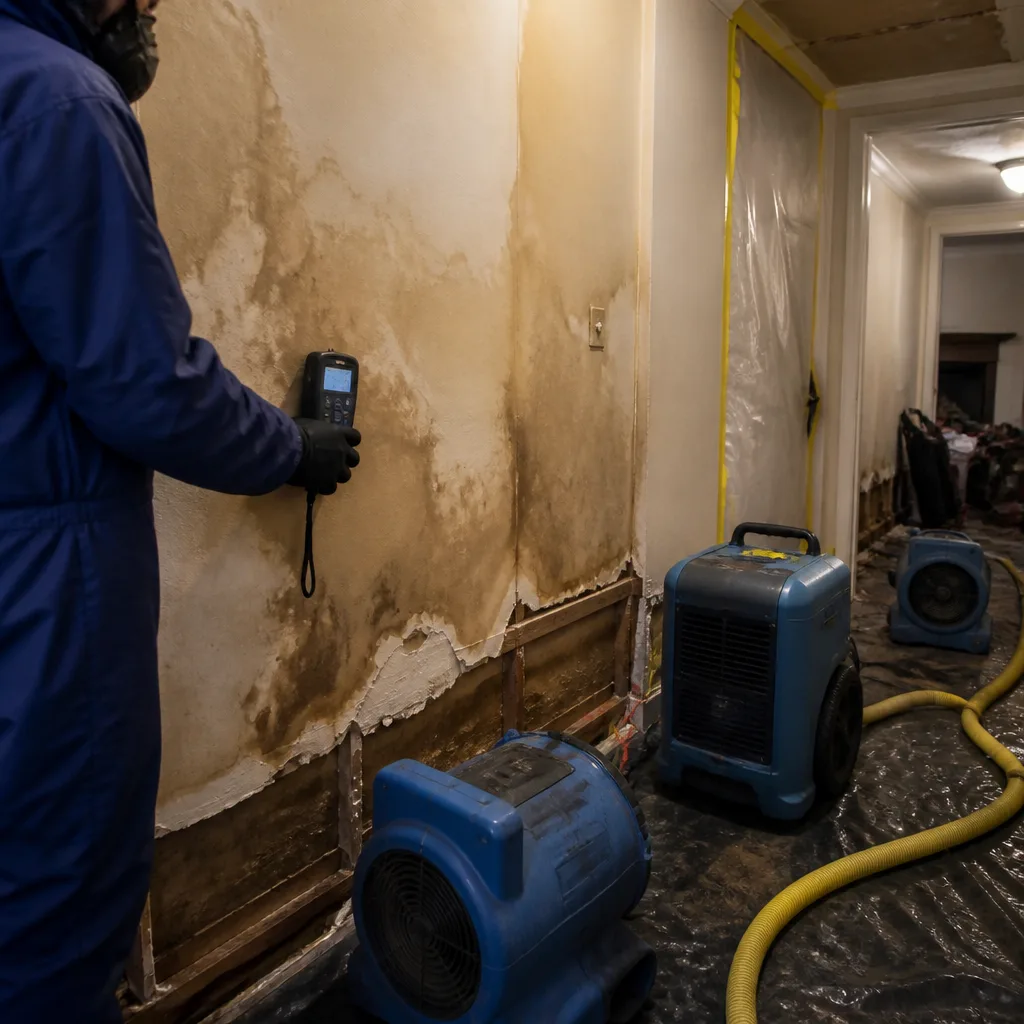
Paramus housing stock makes this worse. Homes built in the 1950s through the 1980s, which cover a large share of the borough’s residential neighborhoods, often have wood framing sitting directly on concrete slabs, sometimes without a proper moisture barrier. That means water on a basement floor doesn’t just sit on the slab. It wicks up into wall framing through capillary action, and it spreads horizontally under flooring. You cannot see this with the naked eye. You can’t feel it with a hand on the wall. You need a moisture meter and a thermal imaging camera to find it, because drywall can read 8 percent moisture on the face while the bottom six inches behind the baseboard is reading 28 percent.
In our experience, a homeowner with box fans and a dehumidifier dries the top layer and misses the cavity. That’s not a criticism. It’s physics. Evaporation happens where air moves, and air doesn’t move behind baseboards or inside wall cavities. The dry standard for wood framing is below 16 percent moisture content, and for drywall, below 12 percent. Rental equipment, even when it’s good equipment, doesn’t give you a way to verify you hit those numbers where it matters.
Professional Equipment vs. What You Can Rent
The equipment question is where a lot of homeowners start, because it feels like the most concrete comparison. If a restoration pro is going to charge me thousands, could I rent similar gear for a few hundred and do the same thing? It’s a fair question, and it deserves a straight answer.
Here’s what a professional crew from Floodline Restoration Co. brings to a typical Paramus basement job, and what rental equipment actually delivers.
- Extraction: A pro truck brings a truck-mounted extraction unit pulling 14 to 16 inches of mercury, or a portable unit pulling 8 to 10 inches. A rental carpet extractor pulls maybe 3 to 4 inches. The difference is hundreds of gallons of water left in the carpet pad, the subfloor, and the grout lines.
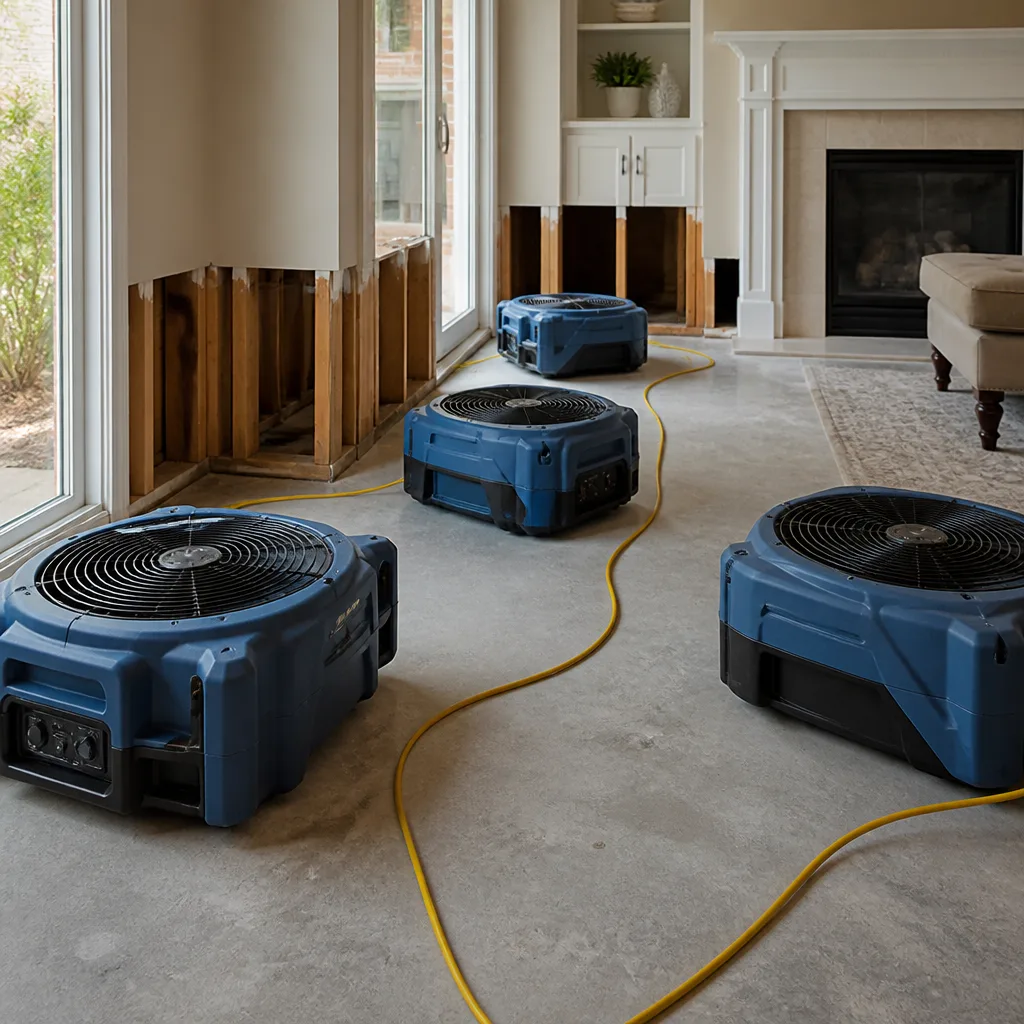
- Air movers: Professional units from B-Air and Dri-Eaz move 2,500 to 3,200 cubic feet per minute and are placed in a specific vortex pattern based on the room geometry. Rental box fans move air in one flat direction. The air-mover placement matters as much as the unit itself.
- Dehumidification: A pro setup uses a low-grain refrigerant dehumidifier, like the Phoenix units our crews run, pulling 130 to 170 pints per day. A rental dehumidifier from a big-box store pulls 30 to 50 pints and often shuts off or struggles in cooler basement temperatures.
- Drying systems for cavities: Injectidry systems force air directly into wall cavities and under cabinets through small ports. This is the only way to dry inside walls without cutting them open. It is not available as a rental, period.
- Verification: A pro job ends with a moisture map and daily readings logged until the dry standard is met, using meters calibrated to the materials being tested. A rental job ends when the floor feels dry to the touch, which, again, is not the same thing.
Rental equipment has a place. We’ll say it plainly. For a small clean-water spill on concrete, a rental carpet fan and a dehumidifier can finish a job that never needed a professional in the first place. The problem is that most homeowners don’t know which category their job falls into, and the equipment rental desk doesn’t know either.
Real Cost Comparison: Paramus Market Numbers
Homeowners in Paramus comparing DIY costs to professional quotes are often surprised by how the numbers actually land. Once you add up rental fees, the electricity to run heavy equipment for days, your own time, and the materials you’ll inevitably need to replace anyway, the savings shrink. And those numbers don’t include the cost of a mistake.
Here’s a realistic breakdown for a moderate water event in Paramus, something like a failed sump pump during a spring storm that left water across 400 square feet of a finished basement.
- Rental equipment (3 days): $280 to $450 for a dehumidifier, two to three air movers, and an extraction unit from a regional rental center.
- Electricity to run that equipment 72 hours straight: $60 to $120, depending on your PSE&G rate and the equipment’s actual draw.
- Your time: If you take a day off work to manage the cleanup, that’s a day of income or PTO. For many Paramus homeowners, that’s $300 to $600.
- Replacement materials you’ll buy anyway: Carpet pad is almost never salvageable after a flood. For 400 square feet, expect $400 to $700 for pad plus tack strip replacement. Baseboard for a typical basement runs another $150 to $350.
- Total realistic DIY outlay: $1,200 to $2,200, with imperfect drying and no written guarantee.
Now the professional numbers for the same job:
- Water extraction and setup of drying equipment, day one: $900 to $1,800, depending on how much standing water remains and how many rooms are affected.
- Daily monitoring and equipment, days two through four: $300 to $500 total for the equipment and daily readings, already included in most mid-range estimates.
- Removal of unsalvageable materials (pad, tack strip, baseboard, any wet insulation): $500 to $1,200.
- Full professional cost for this scenario: $2,800 to $5,500, with a written moisture log, photo documentation for your carrier, and a 90-day guarantee.
The DIY route on a job this size often saves $1,500 to $2,000 on paper. If the drying is incomplete and mold develops inside the wall cavity, the remediation cost in Bergen County runs $3,500 to $12,000, and that’s before putting the room back together. The math works in favor of DIY only when the job is genuinely small and contained.
Insurance and DIY: What Your Carrier Expects
Paramus homeowners carry flood insurance either through NFIP or, for some newer construction, through private flood policies. Most standard homeowners policies also cover sudden internal water events: a burst supply line, a failed water heater, an overflowing washing machine. What many homeowners don’t realize is that how you handle the first 48 hours affects how smoothly the claim goes.
Insurance carriers expect three things from a restoration job:
- Documentation of the initial damage. Photos before anything is moved or demolished. Time-stamped images showing standing water levels and the path of intrusion.
- Professional drying records. A moisture log showing initial readings, daily readings, and final readings that demonstrate the structure met the dry standard. Carriers have gotten stricter on this in recent years. We’ve seen claims where DIY drying with rental equipment led to a denied supplemental claim later, because the homeowner couldn’t produce documentation that the space was actually dried.
- A clear scope of work. Carriers want to see what was removed, what was dried, and what needs reconstruction, in writing, from a company that knows how to bill in the format adjusters expect.
If you do the work yourself, you’ll likely be reimbursed only for materials, not for your time, and the burden of proving the job was done correctly falls entirely on you. If you bring in a professional restoration company, the documentation is part of the service. Floodline Restoration Co. has been handling direct insurance billing for Paramus homeowners since 2010, and our crews photograph everything from the first visit through the final moisture reading. Your adjuster can call us directly, and you never have to be the messenger between your contractor and your carrier.
The Mold Timeline: Why Hours Matter
Mold germination is not a gradual process. It happens on a predictable schedule that every Paramus homeowner should know.
- Hours 1 to 24: Water spreads, wicks upward through drywall, and saturates porous materials. Carpet pad acts like a sponge. Wood framing begins absorbing moisture. Mold spores, which are already present in every home, have not yet germinated.
- Hours 24 to 48: Spores that landed on wet organic surfaces begin to grow. The surface may look fine. The process has already started at the microscopic level.
- Hours 48 to 72: Visible mold colonies can appear, often as faint discoloration on drywall or the back side of baseboards. The musty odor becomes noticeable to most people, even if they can’t locate the source.
- Beyond 72 hours: Mold is actively colonizing wherever moisture remains. Drywall may need to be cut out, insulation replaced, framing treated. Remediation costs escalate, and the affected area expands.
This timeline is why extraction and professional drying need to start the same day, not later in the week. It’s also why Paramus homeowners facing a basement flood on a Friday evening should not wait until Monday morning to address it. The water does not take weekends off. Neither do we.
Common Mistakes to Avoid
- Waiting to see how bad it gets. Water spreads horizontally and upward, never downward on its own. The basement you saw at 8 a.m. is worse by noon, and what could have been extraction and drying becomes tear-out and rebuild. In Paramus, where clay soil holds water against foundation walls, a slow seep becomes a full intrusion faster than homeowners expect.
- Using a household dehumidifier and calling it a day. A residential unit pulling 30 pints per day cannot keep up with hundreds of gallons of water in carpet pad, drywall, and framing. It’s like bailing a boat with a coffee cup.
- Pulling up carpet but leaving the pad. Carpet pad is porous and almost never dries properly once saturated. Leaving it in place guarantees mold underneath the carpet you worked so hard to save. The pad is sacrificial. It goes.
- Forgetting about the baseboards. Water wicks up behind baseboards and into drywall. If the baseboards stayed in place during drying, the wall cavity behind them stayed wet. Baseboards are inexpensive to remove and replace. The mold behind them is not.
- Airing things out on a humid Paramus summer day. Opening windows when outdoor humidity is 70 percent or higher brings more moisture into the space. Fans are fine. Open windows are a mistake, except in dry winter conditions.
- Assuming sewage backup can be cleaned with bleach. Category 3 water, which is what backs up from a sewer line or sits with floodwater, carries bacteria, parasites, and viruses that bleach at household concentrations does not reliably kill. This is a professional remediation job, full stop, and it requires proper PPE, controlled demolition, and antimicrobial treatment.
- Skipping the moisture verification. “It feels dry” is not a measurement. Rent or buy a moisture meter, and check the baseboards, the bottom six inches of drywall, and the subfloor, not just the surface. If you don’t have a meter and don’t plan to buy one, that’s a sign the job is bigger than DIY.
When to Call a Professional
Call a restoration company when the water came from outside or from a sewer line. Call when water touched drywall, insulation, carpet pad, hardwood, laminate, or any finished surface. Call when the affected area is bigger than a bathroom floor. Call when you can smell something off and can’t locate it. Call when your insurance carrier is involved and you need documentation that will hold up under review. And call when the water has been sitting for more than a few hours, because the mold timeline doesn’t reset while you think it over.
Floodline Restoration Co. offers free estimates in Paramus. Call (640) 333-9625 and a live person answers, any hour, any day. We’ll tell you honestly whether you have a DIY job or a professional one, and we’ll put the recommendation in writing.
Frequently Asked Questions
Professional water damage restoration in Paramus typically runs $2,800 to $6,500 for a moderate basement flood covering several hundred square feet, with smaller jobs starting around $1,200 and extensive jobs with reconstruction exceeding $15,000. The final cost depends on the water category, how long it sat, how much drywall and flooring was affected, and whether mold remediation is required. Call (640) 333-9625 for a free estimate specific to your home.
You can save money on DIY flood cleanup in Paramus only when the affected area is under 15 square feet, the water is from a clean source, and no drywall or flooring was touched, with realistic savings of $800 to $1,500 on those small jobs. On larger jobs, the savings shrink dramatically once you account for rental equipment, electricity, replacement materials, and the risk of incomplete drying. When DIY drying fails and mold develops inside a wall cavity, the subsequent remediation usually costs more than professional restoration would have from the start.
Most Paramus homeowners policies cover sudden water damage from internal sources like burst pipes, failed water heaters, and overflowing appliances, but not groundwater seepage or sewer backup unless you carry specific endorsements or a flood policy. Your carrier will expect professional drying records and photo documentation, which is one reason many Paramus homeowners choose a restoration company that bills insurance directly. Floodline Restoration Co. coordinates with your adjuster and documents every step of the job.
Floodline Restoration Co. dispatches crews to Paramus homes the same day you call, including nights, weekends, and holidays, because a live dispatcher answers the phone 24 hours a day, 7 days a week. We know that every hour of delay after 24 hours increases the odds of mold growth, so we prioritize calls where water is actively spreading or has been sitting for more than a day. Extraction equipment runs on the first visit, not days later.
If mold is visible on more than 10 square feet of surface, or if the mold is inside wall cavities or under flooring, you need professional mold remediation, not a cleaning, because surface cleaning leaves the moisture source intact and lets the problem regroup. Small surface mold on non-porous material can sometimes be cleaned by a homeowner with proper protection and the right antimicrobial products, but mold on drywall, insulation, or carpet pad usually means removal of the affected material. An honest assessment is part of what we do in Paramus every week.
Floodline Restoration Co. deals with your insurance adjuster directly, handling the documentation, the scope of work, and the billing so you don’t have to coordinate between your contractor and your carrier. We’ve been doing it for Paramus homeowners since 2010, and our direct insurance billing means you see the same paperwork your adjuster sees. You still own the claim; we just handle the legwork.
The Bottom Line
DIY damage restoration has a place, and that place is small. A clean-water spill on a concrete floor, caught immediately, with under 15 square feet of impact, is a homeowner’s job. Everything bigger than that belongs in professional hands, because hidden moisture in Paramus basements turns into mold on a predictable schedule, and the tools that find and stop that moisture are not available at the rental counter. The cost math on a real flood favors a professional restoration company from the start, especially when insurance is involved. If you’re not sure which category you’re in, call (640) 333-9625 and ask. We’ll give you a straight answer, whether or not you hire us, and if you do hire us, we’ll stand behind the work in writing with the Floodline Restoration Co. home 90-Day Done Right Promise.
Written by Curt Bowman, Owner at Floodline Restoration Co., serving Paramus since 2010.