
IICRC Water Damage Restoration in Paramus: A Homeowner’s Guide
IICRC certification is not a plaque a company hangs in the office. It is a written standard that tells a restoration crew exactly what moisture readings to hit, how long drying should take, and what documentation they owe you before they pack up. Most Paramus homeowners never see that standard until a mold problem appears six months after the walls were closed back up. This guide explains what the IICRC S500 actually requires on your job, so you can hold any crew accountable while the equipment is still running, not after the claim is closed.
If you’re dealing with water in your Paramus home right now and would rather skip the reading, call Floodline Restoration Co. home at (640) 333-9625. A live dispatcher answers, and a certified crew can be on the way today.
What the IICRC S500 Standard Actually Requires On-Site
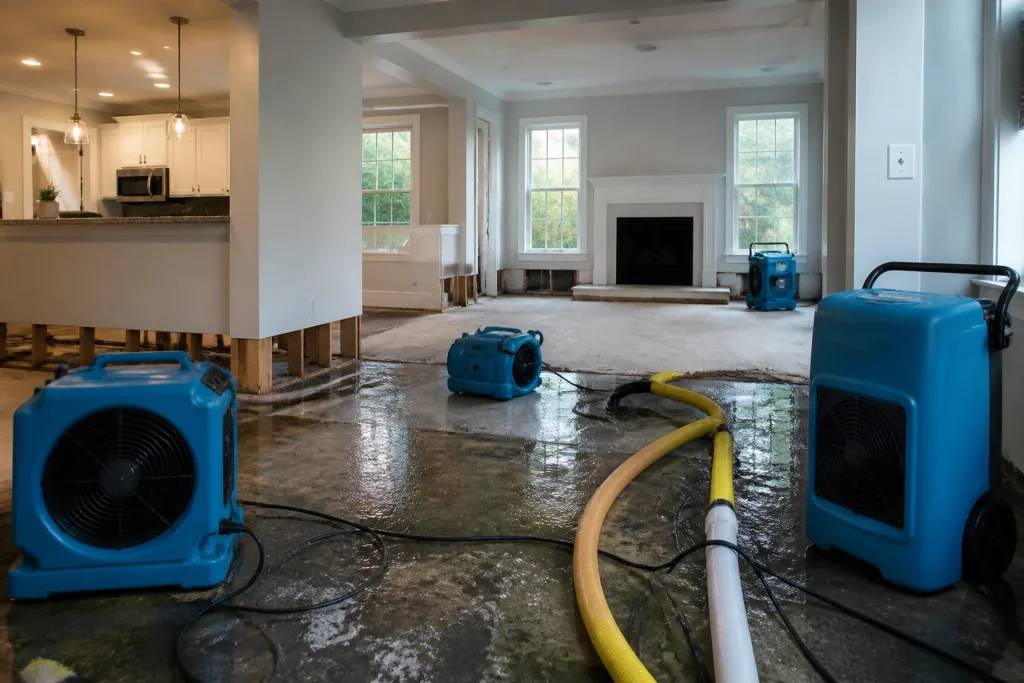
Here’s what most homeowners in Paramus don’t realize: the IICRC S500 is a measurable checklist, not a vibe. A certified technician has to document specific conditions before, during, and after drying. When a crew shows up at a flooded ranch on a street like Farview Avenue, the standard says they need to take psychrometric readings: temperature, relative humidity, and moisture content in the air and in the materials. Those numbers determine which drying equipment gets placed where and how long it stays.
The S500 also assigns drying goals by material class. Drywall, hardwood, concrete, and plaster each have their own target moisture readings. Bergen County’s older housing stock complicates this. Plaster walls from a 1950s colonial hold water differently than modern drywall. Original hardwood floors over a flooded basement in the Spring Valley Road area can cup and crown if drying is rushed or skipped. The standard accounts for this with class and category designations that dictate the drying plan. A company that skips these readings is guessing. A company that logs them is following the standard you’re paying for.
- Psychrometric readings: Temperature, humidity, and dew point logged at intake and daily after that.
- Moisture mapping: A room-by-room diagram showing where walls, floors, and subfloors are wet, and by how much.
- Drying goals by material class: Plaster, hardwood, concrete, and carpet all have different finish-line readings.
- Daily moisture log: Written readings from every affected area until every surface hits its dry standard.
Company Certification vs. One Tech With a Card
This is the question most Paramus homeowners never know to ask, and it matters more than the quote. At Water Damage Restoration in Paramus, we hear stories from people who hired a company where exactly one technician carried an IICRC card. The sales call sounded professional. The crew that showed up was a different story.
Here’s the difference and why it matters for liability. A firm with IICRC certification has met the standard’s requirements at an organizational level: documented training procedures, certified supervisors on staff, and a quality control process that ties back to the S500. A company where one tech holds a card can legally say “IICRC certified” on the truck, but the three people doing the actual extraction on your soaking basement in the Arcola section may have never read the standard. If the job goes wrong and you end up in a dispute with your insurance carrier over secondary damage, the documentation trail, or the lack of one, tells the story. A firm certification gives you a paper trail. A lone card does not.
Floodline Restoration Co. trains every technician to IICRC, RIA, and IFA standards. Not just the person who answers the phone. Not just the estimator. The people carrying the Dri-Eaz and Phoenix equipment into your home have all done the training. That is the point of the standard: consistent, documented work, every time.
How to Read a Moisture Log Like a Homeowner Who Knows What They’re Looking At
You should not have to trust a crew when they say your house is dry. The moisture log is the receipt. Here is what the numbers mean and what to look for when the technician hands you the clipboard.
Wood typically needs to come in at or below 12 to 16 percent moisture content, depending on the room and the material. Drywall should read dry on every meter across the affected area, not just in the corners. Concrete can hold moisture longer, but the readings should trend down every single day. If a log shows the same elevated number three days in a row with no trend drawn, the drying plan is not working. The S500 says the technician has to adjust the setup when readings plateau. A crew that just lets the fans run and hopes is not following the standard.
In our experience, the most common place this falls apart in Paramus is the basement. A homeowner on a street near Route 17 had a water heater fail and saturate a finished basement. The drying crew took initial readings, set equipment, and came back in four days saying it was dry. The log showed the concrete subfloor still at 98 percent relative humidity. That is not dry. That is dry enough for mold to start where no one can see it. The standard says the job is finished when the readings hit the targets, not when the rental period on the fans ends.
Why IICRC Documentation Is the Same Evidence Your Insurance Adjuster Needs
Insurance adjusters do not argue with filled-in moisture logs. They argue with gaps. When a Paramus homeowner files a water damage claim, the carrier wants proof that the damage happened, the response was appropriate, and the drying was completed to an accepted industry standard. The S500 gives them exactly that standard in writing, so a documented job is faster to close and harder to dispute.
This is where Mold Remediation in Paramus ties in directly. If a water job is dried to the S500 finish line and logged daily, secondary mold should not happen. If mold does appear later, the log is the evidence that separates a legitimate new cause from a botched initial drying. The adjuster can see the daily readings, the equipment used, and the final numbers that match the dry standard. No log means the claim becomes a word-versus-word fight, and the homeowner usually loses that one.
We have run plenty of jobs where the homeowner thought the insurance conversation was their battle to fight alone. It is not. Floodline crews bill the carrier directly and hand the adjuster the same log the homeowner gets. Same numbers, same day, no game of telephone.
Bergen County Construction and Why the S500 Is Built for It
Paramus has a particular mix of housing that makes cookie-cutter drying plans fail. Split levels with a half basement. Garages converted into dens. Original hardwood under three layers of flooring, which makes moisture linger where ordinary readings won’t catch it unless someone knows to check. Colt-style houses and slab-on-grade additions from three different decades on the same lot. The S500 addresses material classes specifically because variation like this exists. A one-size drying plan does not.
We pulled one out of a converted garage over near the Paramus Park area a while back. Original slab, vinyl plank flooring, drywall over the old garage door opening. The moisture hid in the bottom plate of the wall framing, behind the vinyl baseboard. A quick reading on the floor said it was fine. A moisture map of the wall said otherwise. That is the difference between following the standard and looking at one number.
Plaster walls are another Bergen County classic. They absorb water slowly and release it just as slowly. If a tech takes one reading from the face of the wall and calls it good, the lath behind it can stay wet for weeks. The S500’s documentation process pushes for readings at multiple depths. A homeowner who knows to ask for that is already ahead of most of the claims we get called in to correct.
What Questions to Ask Before Anyone Sets Up a Fan
Write these down. Ask them in this order. Anyone who hesitates is telling you something useful.
- Is the company itself IICRC certified, or just one technician? Ask to see the firm certificate, not a card. Firm certification means the whole operation follows the standard.
- Will I get a written moisture map and a daily log, not just a verbal “it’s dry”? The log is your proof. Get it in writing from day one.
- What dry standard are you drying to, by material? Wood, drywall, concrete, and plaster each have target numbers. If the answer is vague, walk.
- Who talks to my insurance adjuster, and will you bill them directly? You should never be the middleman. The restoration company and the carrier should handle the paperwork.
- If readings plateau, what is the plan to adjust the equipment? The S500 requires changes when drying stalls. A company that won’t commit to this is renting you fans, not drying your house.
Related services in Paramus: Fire & Smoke Damage Restoration in Paramus follows the same documentation discipline, with the same daily logging and written standard, because a fire job gone wrong creates a water job from the suppression system.
The Bottom Line
The IICRC S500 is the closest thing a Paramus homeowner gets to a written warranty on the drying process itself. It sets the numbers. It requires the log. It dictates what finished actually means. Most companies will not volunteer this, but now you know what to ask. If a crew will not show you readings, produce a daily log, or name the dry standard they are hitting for wood, drywall, and concrete, you are not looking at a certified firm. You are looking at a company that hopes you won’t check.
If you’re in Paramus and dealing with water, call (640) 333-9625. Floodline Restoration Co. gives free estimates, answers the phone with a live person, and follows the S500 because it is the job, not a marketing line. We are at Floodline Restoration Co. home when you need us.
Frequently Asked Questions
IICRC certification means the restoration company follows the S500 standard, a written set of requirements for moisture readings, drying goals, equipment placement, and daily documentation. A firm-certified company trains all its technicians and supervisors to that standard. A company where only one tech holds a card is not the same thing, and the documentation requirements are what make the difference when a claim is disputed.
The moisture log tells you. Wood should read at or below its material-specific target, usually 12 to 16 percent depending on the space. Drywall should read dry across the entire affected area. Concrete should trend down every day. If the log shows the same elevated reading for three straight days with no equipment change, the job is not done and the standard says the crew must adjust the setup. Call (640) 333-9625 if you want a second look at a log from another company.
Yes. Adjusters work against industry standards, and the S500 is the accepted standard for water damage restoration. A complete moisture log with daily readings gives the adjuster exactly what they need to approve the claim. Floodline bills carriers directly and sends the same documentation to the homeowner and the adjuster, so nobody is guessing what happened on the job.
Same day, on the first call. Floodline Restoration Co. has a live dispatcher answering at (640) 333-9625 24 hours a day, every day, including holidays. A certified crew with extraction equipment can be running the same visit. The sooner extraction starts and readings are logged, the less secondary damage the water can do to framing, flooring, and the wall cavities where mold wants to start.
Written by Curt Bowman, Owner at Floodline Restoration Co., serving Paramus since 2010.
Need Damage Restoration Help?
Call Floodline Restoration Co. - licensed & insured, here with fast after-hours help in Paramus.
(640) 333-9625